The results of the 2026 Mathematical Contest in Modeling and Interdisciplinary Contest in Modeling, known as MCM/ICM, were recently announced. This year’s competition attracted 32,213 teams and 93,977 students from 28 countries and regions.
ZJUI students delivered a strong performance, with 40 participating teams receiving multiple awards. According to preliminary statistics, ZJUI students earned 108 individual honors, including 3 Outstanding Winner honors, 19 Meritorious Winner honors, 41 Honorable Mention honors, and 45 Successful Participant honors.
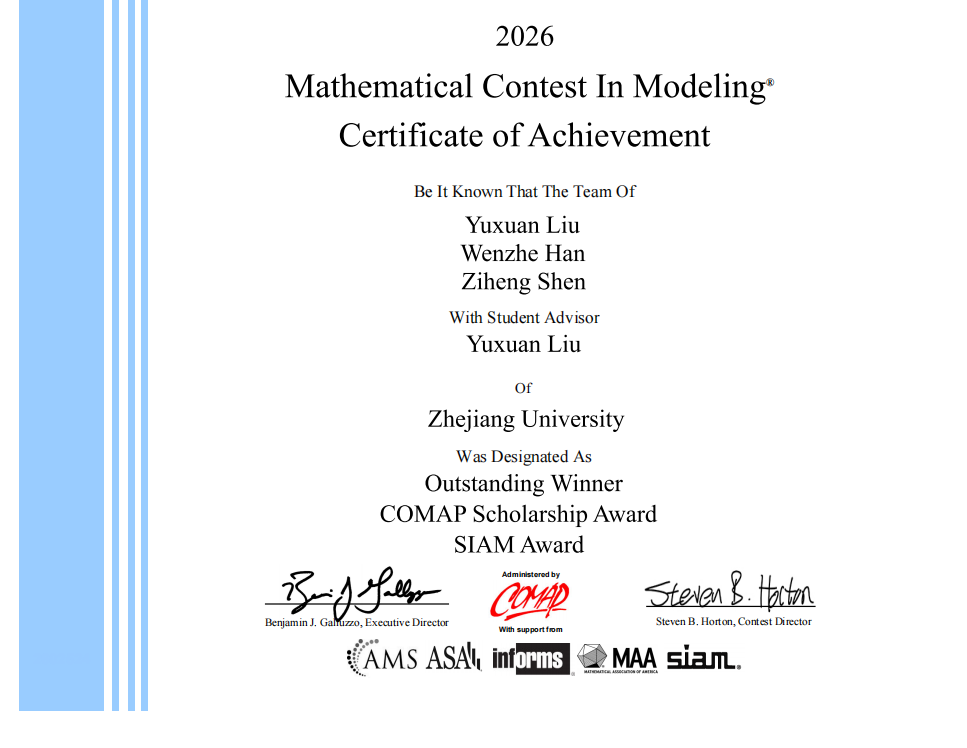
Among them, Liu Yuxuan, Han Wenzhe, and Shen Ziheng, class of 2028 in Mechanical Engineering of ZJUI, were named Outstanding Winners. Competing in Problem B, their team stood out from 5,194 teams and became one of only six Outstanding Winner teams in the category. They also received two special distinctions, that is the Society for Industrial and Applied Mathematics (SIAM) Award and the Consortium for Mathematics and Its Applications (COMAP) Scholarship Award.

The SIAM Award is selected from Outstanding Winner teams in each problem category and the COMAP Scholarship Award is presented to top-performing teams in the year’s MCM/ICM. Together, the two honors recognize the team’s excellence in mathematical modeling, solution design, and academic communication.
The team chose Problem B, “Creating a Moon Colony Using a Space Elevator System,” and submitted a paper titled A Multi-Objective Optimization Framework for Sustainable Lunar Logistics. Set in the context of building a lunar colony for 100,000 people by 2050, the paper addresses the challenge of transporting 100 million metric tons of construction materials from Earth to the Moon. The team developed an Integrated Lunar Logistics Model to balance cost, time, and environmental impact, comparing space elevators, traditional rockets, and a hybrid transportation strategy.
Their analysis showed that space elevators offer long-term cost advantages but are limited by capacity, while rockets can shorten the timeline but involve much higher costs and environmental pressure. The team therefore proposed a hybrid logistics solution and incorporated real-world factors such as equipment failures, tether swaying, launch failures, water supply, and environmental constraints.
This was the team’s first time participating in MCM/ICM. Rather than pursuing overly complex models or advanced algorithms, the team focused on clear problem framing, coherent logic, and effective presentation. They spent much of the first day refining the overall structure of their paper, identifying key modeling modules, and assigning responsibilities before moving into model development. Over the course of the competition, they learned that success in MCM/ICM depends less on technical complexity than on the clarity, coherence, and persuasiveness of the overall solution.
MCM/ICM is one of the world’s leading international modeling competitions for undergraduate students, with problems spanning mathematical modeling, data analysis, engineering systems, social sciences, and interdisciplinary applications. ZJUI’s achievements this year demonstrate its students’ strong foundation in modeling, interdisciplinary collaboration, and English academic writing, as well as the Institute’s continued commitment to international engineering education and innovative practical training.
Source: ZJUI Wechat Public Account,《材料如何运上月球?ZJUI学子问鼎美赛,跻身全球前0.1%》(Editing : WANG Chuxi;Editing in Charge:JIN Xiufang YU Mengyue)