Human embryos frequently stall at a critical developmental checkpoint between fertilisation and implantation, causing clinical problems including infertility and pregnancy loss. After the zygote forms, zygotic genome activation (ZGA) is the first key milestone of embryonic development. At this point, the embryo gradually sheds its dependence on maternal RNA and protein and shifts to autonomous expression of its own genome. Abnormal ZGA is a leading cause of early human embryonic developmental arrest. Although studies in mice and other model organisms have identified many key transcription factors that regulate ZGA, the mechanisms by which ZGA failure leads to early human pregnancy loss remain unclear, and may reflect the distinctive regulation of the genome as it moves from silence to global activation during ZGA, as well as species differences in this process.
Endogenous retroviruses (ERVs) are a distinctive class of retrotransposable elements, remnants of ancient viral infections of the host genome, and are present in large numbers of similar copies throughout the genome. Particular ERV subfamilies are specifically activated during ZGA and transcribed into high-abundance RNAs, forming an important part of the species-specific transcriptome at this stage. The function of these RNAs in embryonic development, however, has not been clearly established.
To address these problems in developmental biology and reproductive medicine, the teams of LIANG Hongqing and ZHANG Dan at Zhejiang University School of Medicine, together with Academician GAO Shaorong of Tongji University and LIU Wanlu of the ZJU-UoE Institute, have for the first time shown that ERVs act as key switches during human zygotic genome activation, synthesising special chimeric RNAs that help the early human embryo pass through this critical developmental stage. The study, titled “Endogenous retroviruses synthesize heterologous chimeric RNAs to reinforce human early embryo development”, was published in Science on 23 January 2026. Deepening the understanding of how the beginning of human life is regulated, it also offers a new approach to improving assisted reproductive technology.
The team found that in embryos that arrested at the eight-cell (8C) stage after in vitro fertilisation, expression of MLT2A1, a subfamily of endogenous retroviruses, fell significantly. The 8C stage is the main period of human zygotic genome activation and is often used in assisted reproductive technology to assess and select embryo quality. Further analysis showed that downregulation of MLT2A1 was closely associated with reduced expression of key ZGA genes, suggesting that MLT2A1 may play an important role in the ZGA process.
To investigate how MLT2A1 regulates ZGA, the team first used nanopore long-read sequencing in human embryos and stem cells to show that, during ZGA, MLT2A1 is not simply expressed on its own but fuses with different downstream genomic sequences to form a wide variety of “MLT2A1 RNA chimeras”. This broad chimeric pattern increases the complexity of the MLT2A1 sequence. The team then used RNA–chromatin interaction (ChIRP) technology to map where MLT2A1 RNA chimeras bind across the genome. They found that MLT2A1 RNA targets key DNA regulatory sequences such as gene promoters, as well as other retrotransposons in intergenic regions, such as LINE1 and Alu. Further experiments showed that the sequences fused downstream of MLT2A1 greatly expand the ability of MLT2A1 RNA to bind genomic DNA, and that this broad genomic binding in turn affects the expression of large numbers of zygotic genes. A series of chimeric RNAs in the MLT2A1 subfamily thus act like a simple key fitted with multiple cuts, creating an amplified effect that more efficiently opens the “combination lock” of zygotic gene expression at the 8C stage.
To explore how MLT2A1 RNA promotes zygotic gene expression after binding genomic DNA, the team identified its localisation and interacting proteins. They found that MLT2A1 RNA is mainly enriched in the nucleus, where it forms distinct nuclear condensates, and that the conserved 5’ MLT2A1 sequence can bind directly to the nuclear protein HNRNPU and recruit RNA polymerase II, the key executor of gene transcription, to promote expression of ZGA genes. To verify the coordinated action of MLT2A1 chimeras and HNRNPU, the team knocked down MLT2A1 and HNRNPU separately and found that nascent RNA synthesis of ZGA genes fell significantly and embryonic development became arrested. These data show that during zygotic genome activation MLT2A1 RNA acts as a busy coordinator, pairing with key DNA binding sites like a key while drawing HNRNPU and RNA polymerase II to nearby DNA, ultimately helping to activate transcription of ZGA genes. This coordinated action of MLT2A1, HNRNPU and RNA polymerase II provides a molecular basis for zygotic genome activation, the global transcriptional activation event.
The human genome contains 3,838 MLT2A1 copies scattered across different genomic sites. The team found that knocking down or knocking out a single MLT2A1 copy not only reduced expression of that particular copy but also affected expression of other MLT2A1 copies, further lowering expression of the whole subfamily. Conversely, overexpressing a single intact MLT2A1 chimeric RNA partially raised overall subfamily expression. Further experiments showed that members of the MLT2A1 subfamily activate one another through sequence similarity, forming a mutual aid network within the family with self-amplifying and collective properties. The subfamily therefore acts as a unit to efficiently coordinate zygotic genome activation, enabling the large-scale, rapid activation of ZGA genes and demonstrating the advantage of multicopy ERV subfamilies in regulating early embryonic development.
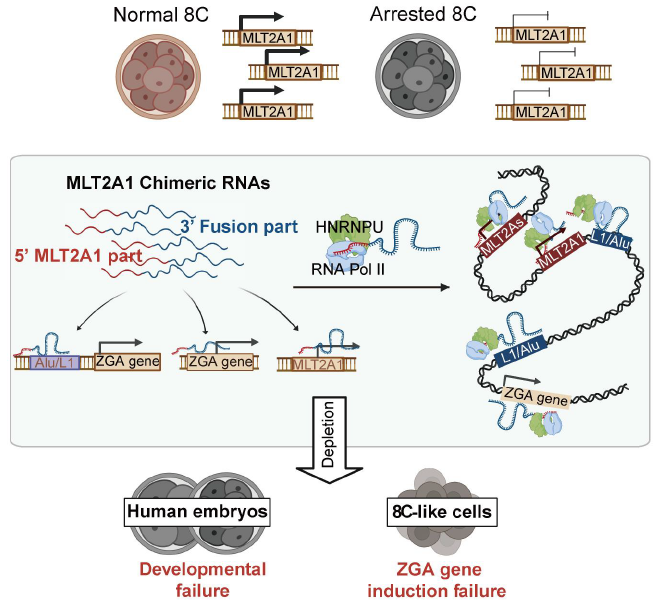
This study reveals new functions and mechanisms of endogenous retroviruses in early human embryonic development and provides potential targets for improving assisted reproductive technology. As a key regulator of zygotic genome activation, MLT2A1 chimeric RNA may become a new biomarker for assessing the quality of embryos produced by in vitro fertilisation.
XIANG Yangquan, QIAN Yuli, LI Zhengyi and WANG Jiaxu of the Women’s Hospital, School of Medicine, Zhejiang University, are co-first authors of the paper.
Reprinted from the BioArt WeChat account, “Expert commentary on Science: LIANG Hongqing, ZHANG Dan, GAO Shaorong and LIU Wanlu’s teams find that endogenous retroviruses are the key to unlocking human embryo development” (Typesetter: Shiyi).